

Director Timos Sellis Moderates a Panel on AI and Health Policy
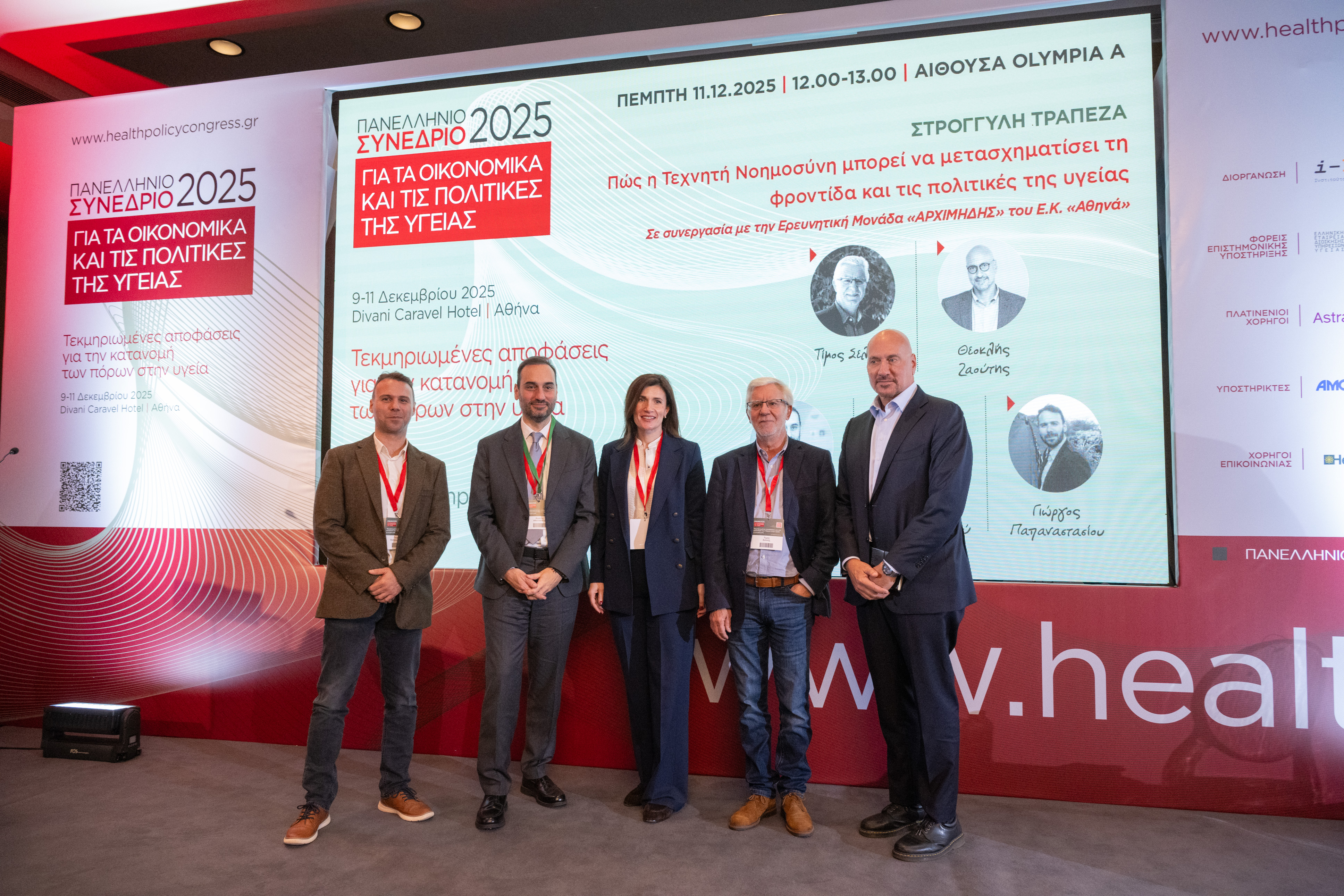
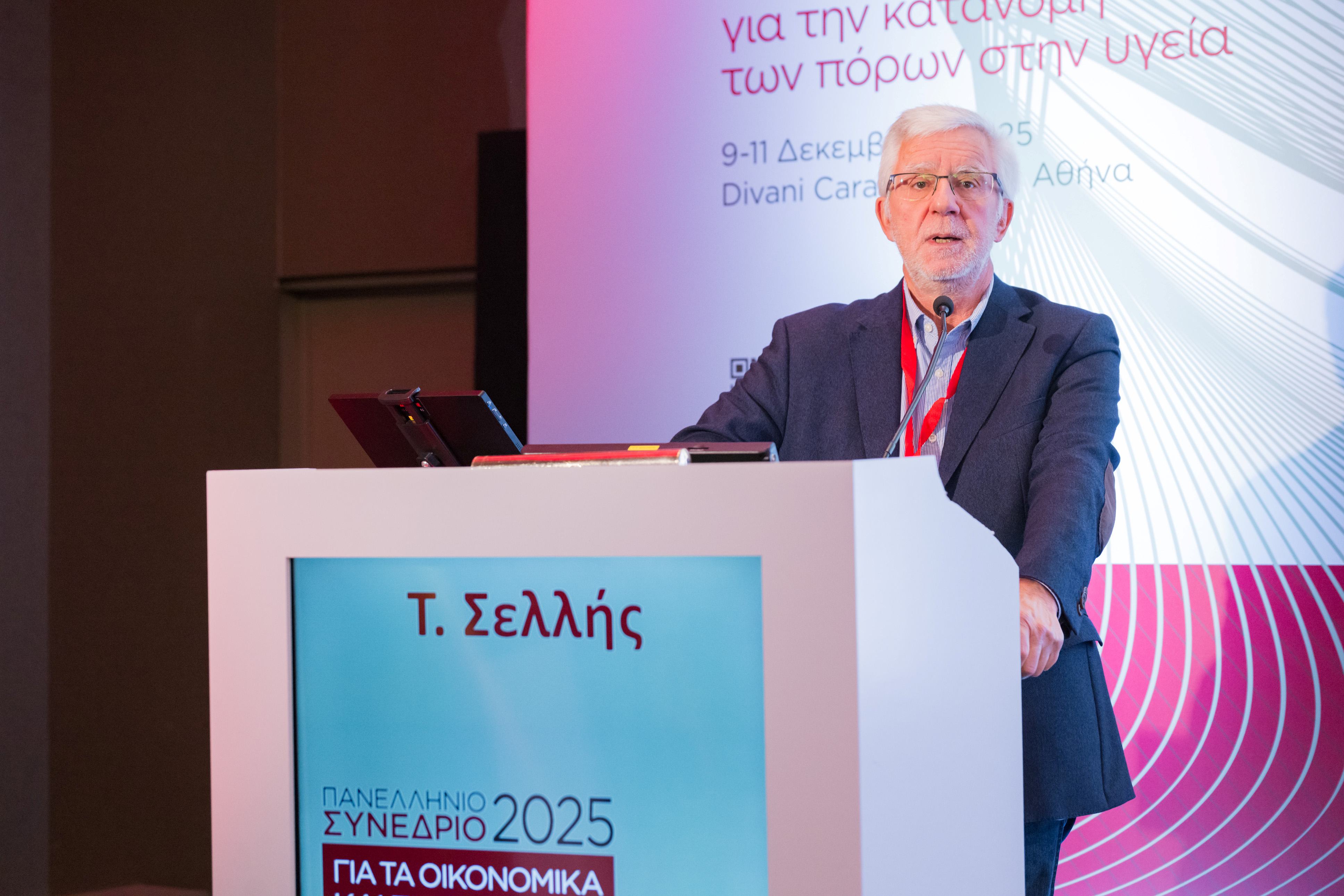
On Thursday, 11 December 2025, during the 2025 Panhellenic Congress on Health Economics and Policy, Professor Timos Sellis moderated an expert panel on ¨How AI May Transform Healthcare and Health Policies” and exchanged views with Professor Costas Athanassakis, Professor Theoklis Zaoutis, Dr. Georgios Papanastasiou, and Dr. Harietta Eleftherochorinou.
Professor Timos Sellis, Director of the Archimedes Unit of the Athena Research Center, Greece, opened the discussion by mentioning that AI has the potential to transform healthcare systems and improve the way we design health policies. He stressed the importance of fairness, transparency, and safety in healthcare systems and invited the esteemed speakers to present their views on how AI may improve the relationship between patients and healthcare systems, how AI can be integrated effectively and responsibly into the medical practice, and how AI can support evidence-based policymaking at the national level.
Professor Kostas Athanassakis, Associate Professor of Health Economics at the University of Western Attica, Greece, and Affiliated Researcher at the Archimedes Unit of the Athena Research Center, Greece, tackled the issue of asymmetric information and the existence of a knowledge gap between patients and healthcare professionals. He believes that AI may help to close this gap and assist patients in making better and well-informed decisions about their health. He also argues that AI systems may be particularly useful in making patient monitoring more effective and thus help with one of the structural problems in the Greek healthcare system.
Professor Theoklis Zaoutis, Professor of Pediatrics at the National and Kapodistrian University of Athens, Greece, and Affiliated Researcher at the Archimedes Unit of the Athena Research Center, Greece, mentioned that in many cases AI systems seem to be more effective at diagnosing diseases than medical professionals. This seems to be the case in radiology, pathology, genomics, the field of biopsies and in some cases of cancer, where cancer cells are very difficult to detect by humans. However, in the case of mental health the picture may be exactly the opposite, due to the inability of systems to display empathy. On a macro level, advanced AI systems may prove very effective at detecting the potential spread of a pandemic, provided that these systems will have access to high quality medical data and open-source information.
Dr. Georgios Papanastasiou, Associate Research Professor at the Academy of Athens, Greece, and Lead Researcher at the Archimedes Unit of the Athena Research Center, Greece, stressed that the best AI systems are the ones that serve the people. He pointed out the challenges faced by AI systems when trying to analyze image data and make medical predictions. He argued that AI does a great job in identifying patterns in complex datasets, but still struggles when it has to provide answers on matters of causality. Dr. Papanastasiou believes that in order for AI to address complex medical problems we need high quality data, a comprehensive framework for metrics, and a skilled workforce of people who can work with AI systems. He is also mentioned that the continuous interaction and engagement between AI experts and medical professionals is critical to the overall success.
Dr. Harietta Eleftherochorinou, Senior Healthcare and AI Executive, and former Vice President of AI Strategy and Operations at IQVIA, raised some very interesting points. She believes that large-scale, historical, national level data for the last five years are needed in order for AI technologies to disrupt and effectively transform healthcare policies and procedures. She praised the excellent work that has been done in providing paperless drug prescriptions in Greece through the IDIKA and EOPYY platforms and mentioned that this data may provide an excellent base for AI technologies to work on and to provide insights tfor the design of more targeted health policies. She also mentioned that Greece has over 200 medical and biotechnology startups and will be strongly supported by the € 200 million EquiFund II initiative in years 2026-2029.
For more information contact us: Dimitris Lazarou, Head of Communications, Archimedes Research Unit in AI, Data Science, and Algorithms, Athena Research Center, Greece, d.lazarou@athenarc.gr