

Θερινό Σχολείο Μηχανικής Μάθησης και Τεχνητής Νοημοσύνης 2026 για Μαθητές (GR/EN)
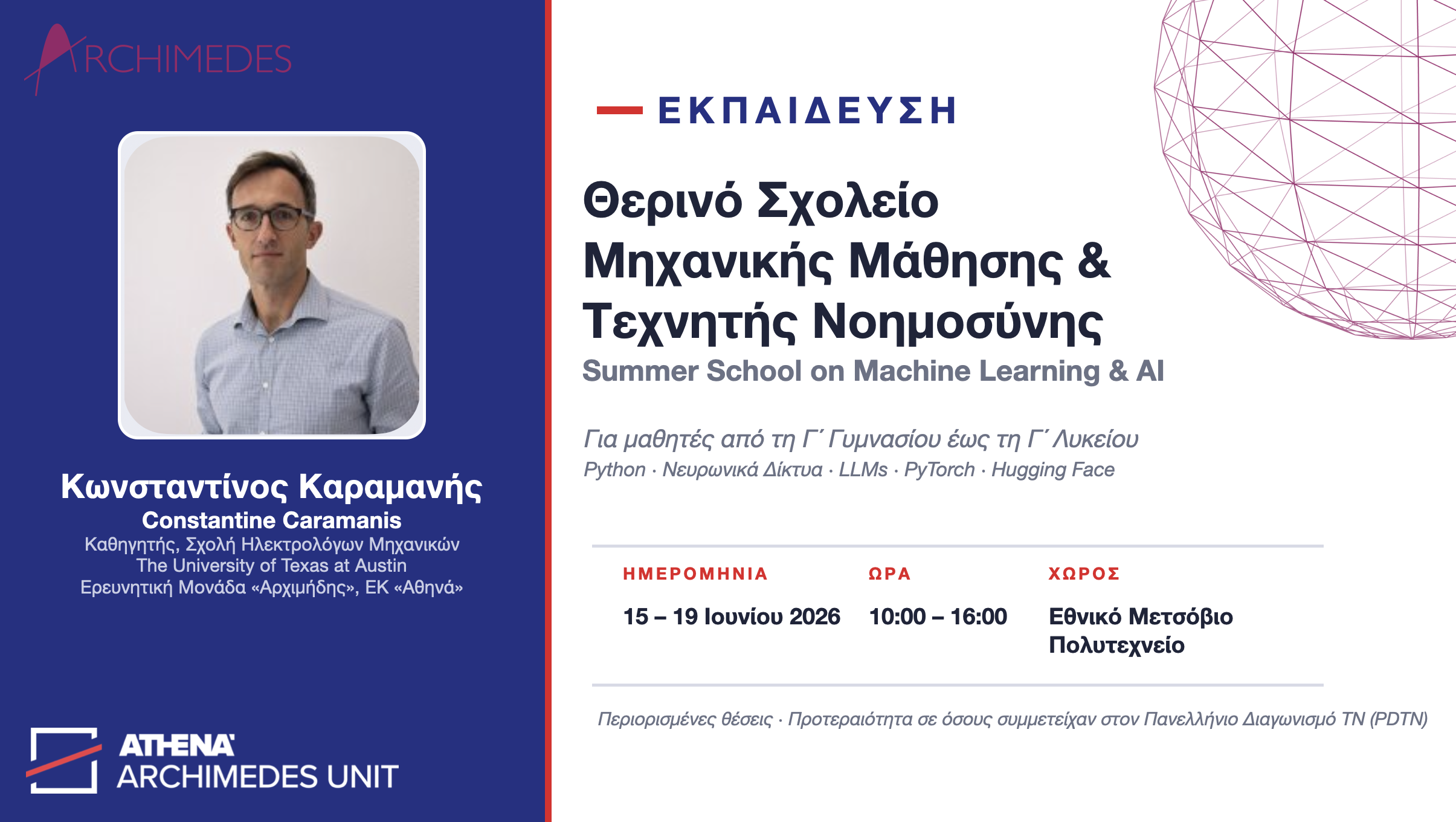
Με μεγάλη χαρά ανακοινώνουμε ότι από τις 15 έως τις 19 Ιουνίου 2026, στη Σχολή Ηλεκτρολόγων Μηχανικών και Μηχανικών Υπολογιστών του Εθνικού Μετσόβιου Πολυτεχνείου, θα πραγματοποιηθεί Θερινό Σχολείο Μηχανικής Μάθησης και Τεχνητής Νοημοσύνης για μαθητές Δευτεροβάθμιας Εκπαίδευσης (Γ΄ Γυμνασίου – Γ΄ Λυκείου), με διδάσκοντα τον Κωνσταντίνο Καραμανή.
Το κείμενο είναι διαθέσιμο στα ελληνικά και στα αγγλικά (English version below).
Τις διαλέξεις θα δώσει ο Κωνσταντίνος Καραμανής, Καθηγητής στη Σχολή Ηλεκτρολόγων Μηχανικών του The University of Texas at Austin (Ερευνητική Μονάδα «Αρχιμήδης», ΕΚ «Αθηνά»).
Διάρκεια: Δευτέρα 15/6 έως Παρασκευή 19/6, 10:00 π.μ. – 4:00 μ.μ.
Απευθύνεται σε: Μαθητές που έχουν ολοκληρώσει τη Γ΄ Γυμνασίου έως και τη Γ΄ Λυκείου και ενδιαφέρονται να μάθουν τις βασικές ιδέες της μηχανικής μάθησης (Machine Learning), των νευρωνικών δικτύων (Neural Networks) και των μεγάλων γλωσσικών μοντέλων (LLMs), καθώς και πώς αυτές εφαρμόζονται σε Python.
Προαπαιτούμενα: Βασική γνώση προγραμματισμού (ιδανικά σε Python), εξοικείωση με το υλικό που παρουσιάζεται σε αυτή τη σειρά διαλέξεων και λογαριασμός Gmail για χρήση του Google Colab.
Στόχος του προγράμματος: Οι μαθητές να αποκτήσουν μια πρώτη ουσιαστική επαφή με τη σύγχρονη τεχνητή νοημοσύνη, τόσο σε θεωρητικό όσο και σε πρακτικό επίπεδο.
Οι πέντε ημέρες θα συνδυάζουν:
- Βασικές ιδέες και έννοιες της μηχανικής μάθησης – εκπαίδευση αλγορίθμων, επιβλεπόμενη μάθηση κ.λπ.
- Υλοποίηση αλγορίθμων σε Python με διάφορα σύνολα δεδομένων, με παραδείγματα από την επεξεργασία φυσικής γλώσσας (natural language processing) και τη μηχανική όραση (computer vision).
- Βαθιά νευρωνικά δίκτυα (Deep Learning).
- Χρήση και εκπαίδευση αυτών των μοντέλων με Python, PyTorch και Hugging Face.
- Ανάλογα με τα ενδιαφέροντα των μαθητών, ορισμένες διδακτικές ώρες θα αφιερωθούν σε πιο προχωρημένο μαθηματικό και αλγοριθμικό υλικό σχετικό με τη μηχανική μάθηση.
Θα καλυφθεί επίσης ύλη σχετική με τα θέματα της Διεθνούς Ολυμπιάδας Τεχνητής Νοημοσύνης.
Τι θα καλυφθεί
Η σύγχρονη μηχανική μάθηση βασίζεται κατά κύριο λόγο σε βαθιά νευρωνικά δίκτυα (deep neural nets), τόσο για προβλήματα μηχανικής όρασης όσο και για την επεξεργασία φυσικής γλώσσας. Το ChatGPT και άλλα παρόμοια μοντέλα είναι χτισμένα ως συνδυασμός πολλών γραμμικών και μη γραμμικών επιπέδων, όπως τα γραμμικά επίπεδα (fully-connected layers), τα συνελικτικά επίπεδα (convolutional layers), τα επίπεδα self-attention και οι συναρτήσεις ReLU. Οι μαθητές θα μάθουν τι είναι αυτά, πότε τα χρησιμοποιούμε και πώς λειτουργούν, στο πλαίσιο των βασικών ιδεών της μηχανικής μάθησης.
Ιατρική απεικόνιση. Το μάθημα έχει ως αφετηρία την υλοποίηση συνελικτικών δικτύων (CNNs) και τη μέθοδο του Transfer Learning, όπως παρουσιάστηκαν στα τελευταία διαδικτυακά μαθήματα. Η εβδομάδα ξεκινά με την υλοποίηση ενός προγράμματος που λύνει ένα θεμελιώδες πρόβλημα της μηχανικής όρασης (Computer Vision), την ταξινόμηση, με χρήση ενός συνόλου δεδομένων ιατρικής απεικόνισης (medical imaging). Η ιατρική απεικόνιση είναι ένας τομέας όπου η μηχανική μάθηση και η τεχνητή νοημοσύνη έχουν ήδη σημειώσει αισθητή πρόοδο: συστήματα τεχνητής νοημοσύνης βοηθούν στη διάγνωση διαφόρων μορφών καρκίνου και άλλων παθήσεων, με αποδοτικότητα που ξεπερνά κατά πολύ ό,τι ήταν εφικτό μέχρι πριν από λίγα χρόνια.
- Το σύνολο δεδομένων προέρχεται από το πρόβλημα της διάγνωσης του καρκίνου του μαστού: ένα ανωνυμοποιημένο σύνολο υπερηχογραφημάτων.
- Θα αναπτυχθούν τα απαραίτητα εργαλεία μηχανικής όρασης:
- PyTorch
- Fully Connected Layers και ReLU
- Convolutional Neural Networks
- Transfer Learning
Από το Transfer Learning στην Παραγωγική Τεχνητή Νοημοσύνη. Η τεχνική του Transfer Learning είναι θεμελιώδης στη μηχανική μάθηση· οι περισσότερες εφαρμογές που έχουμε δει, και θα δούμε τα επόμενα χρόνια, αξιοποιούν ιδέες της. Αποτελεί επίσης τη γέφυρα προς την παραγωγική τεχνητή νοημοσύνη (Generative AI). Η εβδομάδα θα συνεχιστεί με:
- Σημασιολογικές ενσωματώσεις για εικόνες
- Σημασιολογικές ενσωματώσεις για λέξεις (Word2Vec)
- Σημασιολογικές ενσωματώσεις για κείμενο
Οι σημασιολογικές ενσωματώσεις οδηγούν στα μεγάλα γλωσσικά μοντέλα (Large Language Models / LLMs). Θα εξεταστεί πώς χτίζονται και πώς εκπαιδεύονται, καθώς και το πολύ σημαντικό πρόβλημα της αναζήτησης σε βάση γνώσεων.
Με την ολοκλήρωση της εβδομάδας, στόχος είναι οι μαθητές να διαθέτουν τις απαραίτητες γνώσεις ώστε να εφαρμόζουν τις ιδέες και τον κώδικα που αναπτύχθηκαν σε προβλήματα που αντιστοιχούν στα δικά τους ενδιαφέροντα.
Συμμετοχή
Οι θέσεις είναι περιορισμένες. Προτεραιότητα θα δοθεί σε μαθητές που έχουν λάβει μέρος στον Πανελλήνιο Διαγωνισμό Τεχνητής Νοημοσύνης.
Σύντομη περιγραφή του Θερινού Σχολείου: caramanis.github.io/ml_summer_camp
Φόρμα εκδήλωσης ενδιαφέροντος: forms.gle/XtB57kPPcPtYX22v8
English version
Summer School on Machine Learning and Artificial Intelligence 2026 for secondary school students
We are delighted to announce that from 15 to 19 June 2026, the School of Electrical and Computer Engineering of the National Technical University of Athens (NTUA) will host a Summer School on Machine Learning and Artificial Intelligence for secondary school students (Grade 9 to Grade 12).
Lectures will be delivered by Constantine Caramanis, Professor in the Department of Electrical and Computer Engineering at The University of Texas at Austin (Archimedes Research Unit, Athena Research Center).
Dates: Monday 15 June to Friday 19 June, 10:00–16:00
Who it is for: Students who have completed Grade 9 (Γ΄ Γυμνασίου) up to Grade 12 (Γ΄ Λυκείου) and want to learn the core ideas behind machine learning, neural networks and large language models (LLMs), and how to apply them in Python.
Prerequisites: Some basic programming knowledge (ideally in Python), familiarity with the material presented in this lecture series, and a Gmail account for using Google Colab.
Aim: To give students a first substantial introduction to modern artificial intelligence, at both the theoretical and the practical level.
The five days will combine:
- Core ideas and concepts of machine learning: training algorithms, supervised learning, etc.
- Implementing algorithms in Python on a range of datasets, with examples from natural language processing and computer vision.
- Deep neural networks (deep learning).
- Using and training these models with Python, PyTorch and Hugging Face.
- Depending on the students' interests, some sessions will be devoted to more advanced mathematical and algorithmic material related to machine learning.
The programme will also cover material related to the topics of the International Olympiad in Artificial Intelligence.
What will be covered
Modern machine learning relies primarily on deep neural networks, for both computer vision and natural language processing. ChatGPT and similar models are built by combining many linear and non-linear layers, such as fully-connected layers, convolutional layers, self-attention layers and ReLUs. Students will learn what these are, when they are used and how they work, within the framework of the core ideas of machine learning.
Medical imaging. The course builds on the implementation of convolutional neural networks (CNNs) and transfer learning, as presented in recent online lectures. The week begins with implementing a program that solves a fundamental computer vision problem, classification, using a medical imaging dataset. Medical imaging is a field where machine learning and AI have already made significant progress: AI systems help diagnose various cancers and other conditions, with an efficiency far beyond what was possible just a few years ago.
- The dataset comes from the problem of breast cancer diagnosis: an anonymized dataset of ultrasound images.
- Students will develop the necessary computer vision tools:
- PyTorch
- Fully Connected Layers and ReLU
- Convolutional Neural Networks
- Transfer Learning
From transfer learning to generative AI. Transfer learning is a fundamental technique in machine learning, and most of the applications we have seen, and will see in the coming years, build on its ideas. It is also the bridge to generative AI. The week continues with:
- Semantic embeddings for images
- Semantic embeddings for words (Word2Vec)
- Semantic embeddings for text
Semantic embeddings lead to large language models (LLMs). Students will see how LLMs are built and trained, and will discuss the important problem of searching a knowledge base.
By the end of the week, students should have the knowledge they need to apply the ideas and code developed during the course to problems that match their own interests.
Participation
Places are limited. Priority will be given to students who have taken part in the Panhellenic Artificial Intelligence Competition.
Summer School description: caramanis.github.io/ml_summer_camp
Expression of interest form: forms.gle/XtB57kPPcPtYX22v8