archimedes-Artificial Intelligence, Data Science, Algorithms-greece

 
Artificial Intelligence
 
Data Science
 
Algorithms

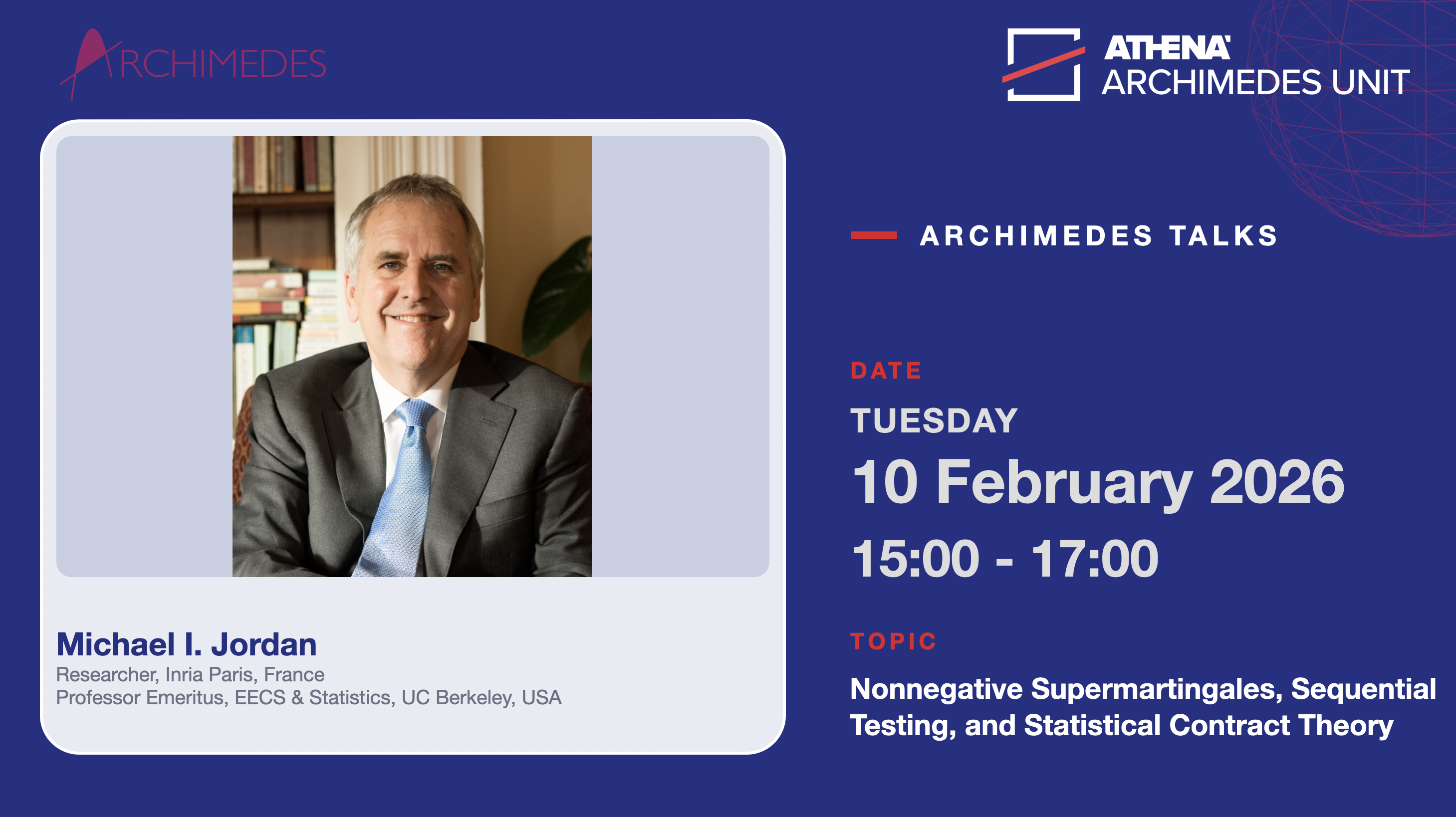
[Archimedes Talks Series] Cognitively motivated deep neural representations and architectures

Dates
2024-10-15 12:00 - 14:00
Venue
Artemidos 1 - Amphitheater
Title: Cognitively motivated deep neural representations and architectures 

Speaker: Assoc. Prof. Alexandros Potamianos  (NTUA, USC)


Abstract: Despite tremendous progress in artificial intelligence we continue to lag behind human capabilities in crucial areas such as generalization, robustness and efficiency - hallmarks of human cognition. This talk proposes a paradigm shift towards cognitively-motivated representations that explicitly incorporate macroscopic cognitive principles such as low-dimensionality, hierarchy, abstraction, neural feedback and sparsity. First, we argue that traditional metric spaces and linear tools are poorly suited for efficient information storage and processing, contrasting sharply with the brain's more effective organizational strategies. We show that a top-down hierarchical manifold representation of low-dimensional, sparse subspaces can achieve human-like performance in both decoding and induction tasks, particularly in lexical semantics. Next we explore the role of feedback mechanisms in the brain, especially feedback-driven deactivation of cortical columns, and present our work on MMLatch, a bottom-up top-down fusion model applied to multimodal sentiment analysis. This research highlights the importance of bidirectional information flow in neural architectures. Finally, we discuss a novel neural network architecture inspired by synaptic pruning during brain development. This approach utilizes long connections instead of traditional short residual connections, naturally pushing information to the first few layers of the network and resulting in sparsity. These networks exhibit behaviors reminiscent of biological brain networks, including enhanced robustness to noise, good performance  in low-data settings, and longer training times. Overall, our work demonstrates that by embracing cognitively-motivated principles in AI architectural design, we can create more efficient, robust, and human-like AI systems capable of improved generalization and induction. 

Bio: Alexandros Potamianos received the Diploma in electrical and computer engineering from the National Technical University of Athens, Greece, in 1990, and the M.S. and Ph.D. degrees in engineering sciences from Harvard University, Cambridge, MA, in 1991 and 1995, respectively. From 1995 to 1999, he was a Senior Technical Staff Member with AT&T Shannon Labs, Florham Park, NJ. From 1999 to 2002, he was a Technical Staff Member and Technical Supervisor with Bell Labs, Lucent Technologies, Murray Hill, NJ. From 2003 to 2013, he served as an associate professor at the Department of ECE, Technical University of Crete, Chania, Greece. Since 2013, he serves as an associate professor at the School of ECE, National Technical University of Athens, Greece. He is also a visiting professor at the Viterbi School of Engineering, University of Southern California, CA and an Amazon Scholar. He is the co-founder of Behavioral Signals, an emotion AI deep tech startup.  He has authored or coauthored over 200 papers in professional journals and conferences, and holds five patents. His current research interests include foundation models. speech processing, dialog and multimodal systems, natural language understanding, machine learning and multimodal child-computer interaction. Prof. Potamianos has served multiple terms at the IEEE Speech and Language Technical Committee and at the IEEE Multimedia Technical Committee. He received a 2005 IEEE Signal Processing Society Best Paper Award. He is an IEEE fellow, an International Speech Communication Association (ISCA) fellow and a fellow of the Asia-Pacific Artificial Intelligence Association (AAIA). 

________________________________________________________________________________

Microsoft Teams Need help?
Meeting ID: 338 882 842 320
Passcode: Vsw5aV

For organizers: Meeting options
________________________________________________________________________________



Vision

To position Greece as a leading player in AI and Data Science

image
image

Mission

To build an AI Excellence Hub in Greece where the international research community can connect, groundbreaking ideas can thrive, and the next generation of scientists emerges, shaping a brighter future for Greece and the world


Welcome to ARCHIMEDES, a vibrant research hub connecting the global AI and Data Science research community fostering groundbreaking research in Greece and beyond. Its dedicated core team, comprising lead researchers, affiliated researchers, Post-Docs, PhDs and interns, is committed to advancing basic and applied research in Artificial Intelligence and its supporting disciplines, including Algorithms, Statistics, Learning Theory, and Game Theory organized around 8 core research areas. By collaborating with Greek and Foreign Universities and Research Institutes, ARCHIMEDES disseminates its research findings fostering knowledge exchange and providing enriching opportunities for students. Leveraging AI to address real-world challenges, ARCHIMEDES promotes innovation within the Greek ecosystem and extends its societal impact. Established in January 2022, as a research unit of the Athena Research Center with support from the Committee Greece 2021, ARCHIMEDES is funded for its first four years by the EU Recovery and Resilience Facility (RRF).


NEWS

 
Archimedes Talk by Eli Baum on

Archimedes Talk by Eli Baum on "ORQ: Scaling Complex Multiparty Computations to Large Private Datasets"

On Monday 4 May, 2026, from 1:00 pm to 2:30 pm, at the Archimedes Amphitheatre (1 Artemidos Street, 15125, Marousi, Archimedes, Athena Research Center, Greece), Eli Baum, a third-year Ph.D. student at  Boston University, USA, and a member of the BU CASP Systems Lab and the BU Security Group, will deliver an Archimedes talk on "ORQ: Scaling Complex Multiparty Computations to Large Private Datasets."

DialRes-LREC 2026 workshop: “Dialects in NLP: A Resource Perspective”

DialRes-LREC 2026 workshop: “Dialects in NLP: A Resource Perspective”

Researchers from the Archimedes Unit of the Athena Research Center, Greece, together with the Athena Research Center team on Dialectal NLP, affiliated with the Institute for Language and Speech Processing, and in collaboration with researchers from George Mason University, are organizing the first edition of the DialRes-LREC 2026 workshop, “Dialects in NLP: A Resource Perspective”, to be held on 16 May 2026. More information is available here: https://dialres.github.io/dialres/index.html.

Antonis Anastasopoulos' Keynote Speech on

Antonis Anastasopoulos' Keynote Speech on "Machine Translation and Low-Resource NLP" from the Athens NLP 2025 Summer School is Now Available Online

Antonis Athanassopoulos, an Assistant Professor at the Computer Science Department of George Mason University,USA, and a Lead Researcher at Archimedes, Athena Research Center, Greece, was one of the keynote speakers at the Athens NLP 2025 Summer School, held at the National Centre for Scientific Research Demokritos in Greece, from 4 to 10 September 2025.His presentation on "Machine Translation and Low-Resource NLP" is now available online.

Christos Papadimitriou Speaks on “Artificial Intelligence: its History, its Present, and its Uncertain Future”

Christos Papadimitriou Speaks on “Artificial Intelligence: its History, its Present, and its Uncertain Future”

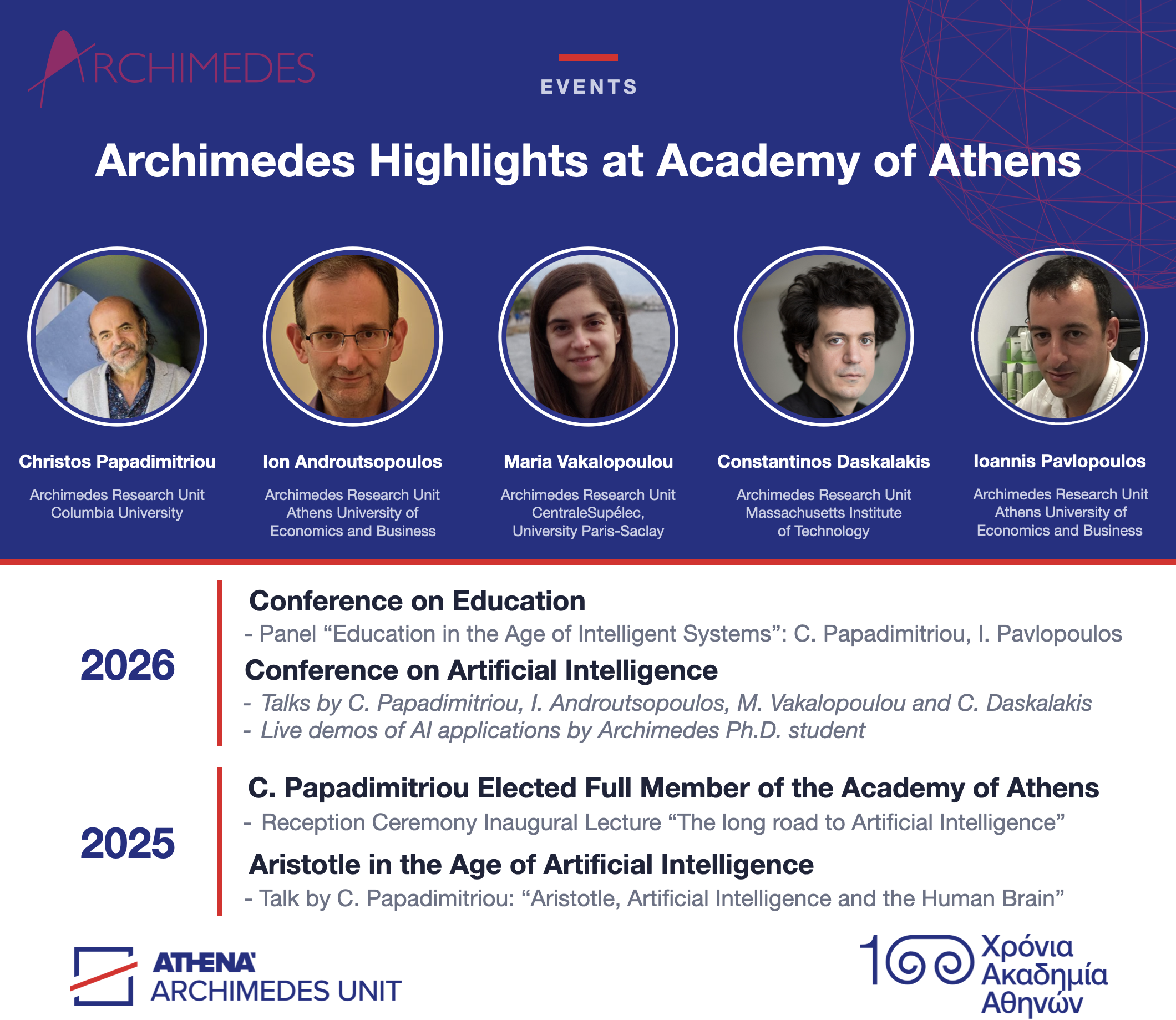
Christos Papadimitriou, Donovan Family Professor of Computer Science at Columbia Engineering at Columbia University, USA, and Principal Scientist at the Archimedes Research Unit of the Athena Research Center, Greece, spoke about “Artificial Intelligence: its History, its Present, and its Uncertain Future” during the ten-year anniversary event of diaNEOsis think tank, which took place on March 11, 2026, at the Stavros Niarchos Foundation Cultural Center (SNFCC).


The project “ARCHIMEDES Unit: Research in Artificial Intelligence, Data Science and Algorithms” with code OPS 5154714 is implemented by the National Recovery and Resilience Plan “Greece 2.0” and is funded by the European Union – NextGenerationEU.

greece2.0 eu_arch_logo_en


Stay connected! Subscribe to our mailing list by emailing sympa@lists.athenarc.gr
with the subject "subscribe archimedes-news Firstname LastName"
(replace with your details)