
Archimedes Talk by Ph.D. Student Panagiotis Antoniadis
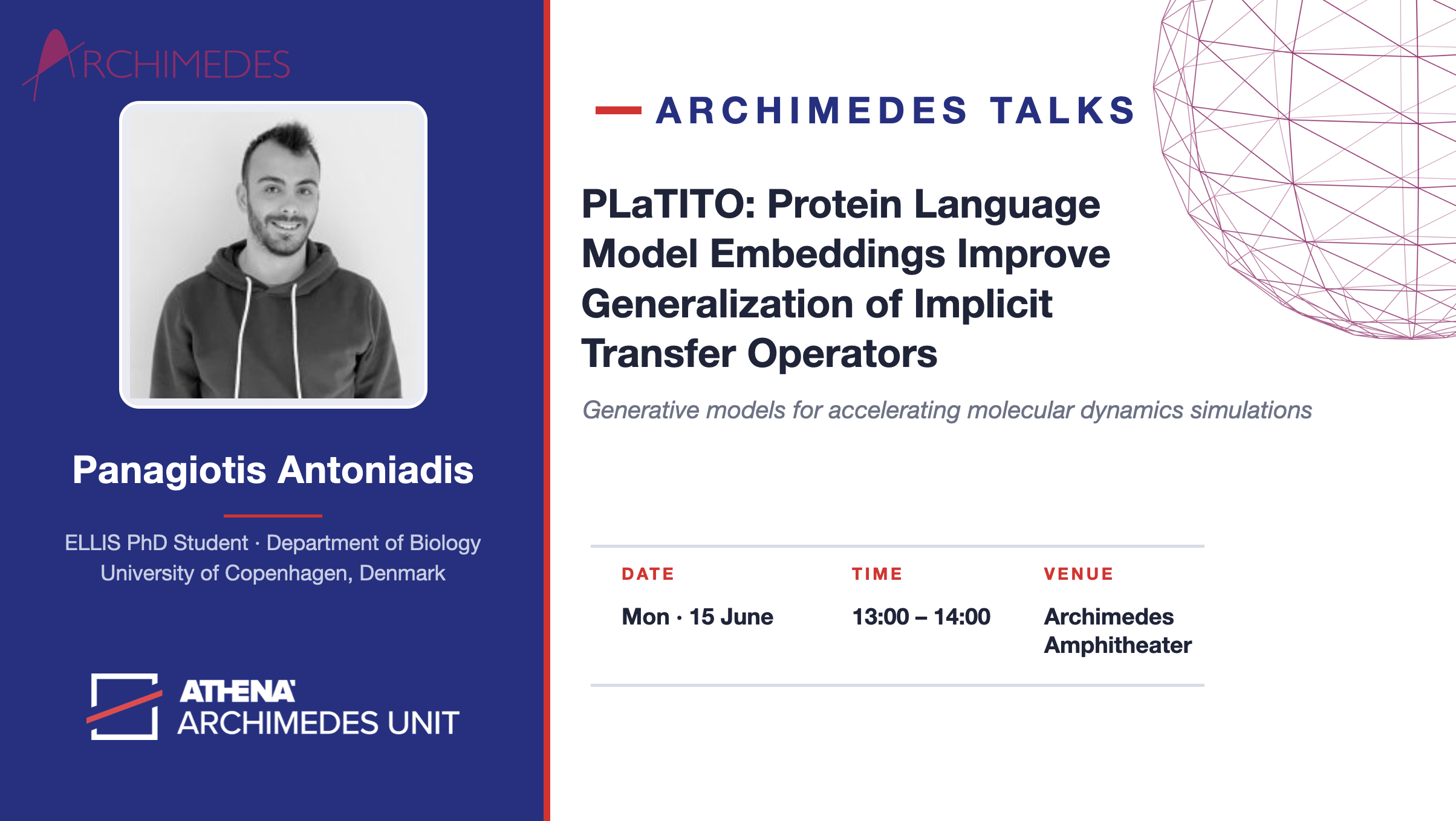
On Monday 15 June, 2026, at 1:00 pm, at the Archimedes Amphitheatre (1 Artemidos Street, 15125, Marousi, Archimedes, Athena Research Center, Greece), Panagiotis Antoniadis, an ELLIS Ph.D. student at the Department of Biology of the University of Copenhagen, Denmark, delivered an Archimedes talk on "PLaTITO: Protein Language Model Embeddings Improve Generalization of Implicit Transfer Operators."
Abstract:
Molecular dynamics (MD) simulations provide a computational bridge from microscopic physical laws to macroscopic observables such as free energies and kinetic rates. However, the prohibitive computational cost of sampling independent samples from high-dimensional molecular distributions (like the Boltzmann distribution) remains a fundamental bottleneck. Recently, Generative Molecular Dynamics (GenMD) [1] methods have emerged which cast MD sampling as a generative modeling problem: neural networks are trained to produce independent samples from target molecular distributions, either from trajectory data or by learning from a potential energy model or force field.
In this talk, I will start with an overview of existing GenMD approaches, covering Boltzmann Emulators [2] that learn to sample the Boltzmann distribution directly and Implicit Transfer Operators (ITO) [3] that approximate long-timescale transition densities from MD. I will then present PLaTITO [4], our recent work on coarse-grained transferable implicit transfer operators for protein dynamics. PLaTITO generalizes to out-of-distribution protein systems by training on diverse off-equilibrium MD trajectories across multiple temperatures. I will show that incorporating auxiliary information from pretrained protein language and structure models substantially improves data efficiency and out-of-distribution generalization of ITO models. At scale, PLaTITO achieves state-of-the-art performance on equilibrium sampling benchmarks for fast-folding proteins and recovers non-Arrhenius folding and unfolding rates, consistent with complex rugged free energy landscapes. Finally, I will discuss current challenges and future directions for training scalable surrogates of MD simulations.
[1] Olsson, "Generative molecular dynamics." Current Opinion in Structural Biology 96 (2026)
[2] Lewis et al., "Scalable emulation of protein equilibrium ensembles with generative deep learning." Science 389.6761 (2025)
[3] Schreiner et al., "Implicit transfer operator learning: Multiple time-resolution models for molecular dynamics." (NeurIPS 2023)
[4] Antoniadis et al., “Protein Language Model Embeddings Improve Generalization of Implicit Transfer Operators” (ICML 2026)
Biography:
Panagiotis Antoniadis is an ELLIS Ph.D. student at the Department of Biology of the University of Copenhagen, supervised by Ole Winther and Simon Olsson. His research focuses on using generative models for accelerating molecular dynamics simulations. He is also interested in large-scale training of DNA foundation models. He holds a BSc and MSc degree in Electrical and Computer Engineering from NTUA, where he completed his thesis on visual emotion recognition under the supervision of Petros Maragos.