

Learning the “Right” Space for Data-driven Modeling and Uncertainty Quantification in Complex/ Multiscale Systems - Dimitris Giovanis (Johns Hopkins University, USA)
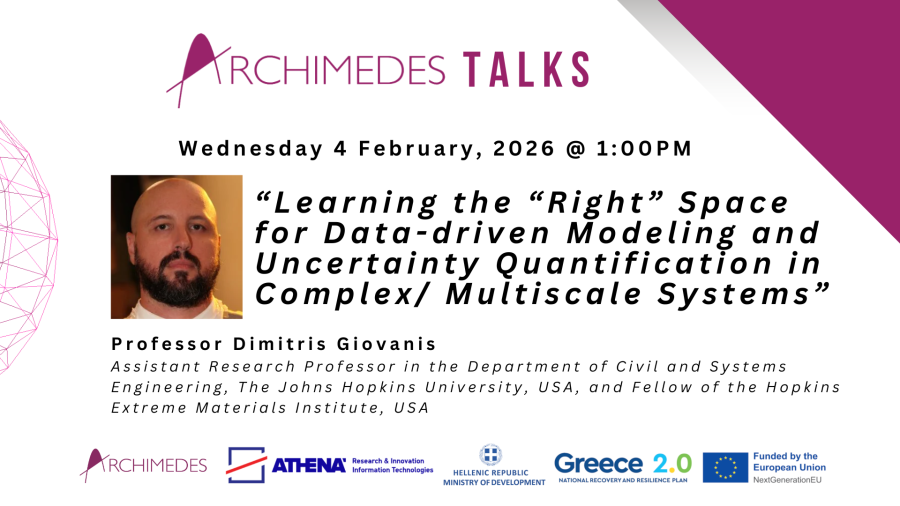
Title: Learning the “Right” Space for Data-driven Modeling and Uncertainty Quantification in Complex/Multiscale Systems
Speaker: Prof. Dimitris Giovanis (Johns Hopkins University, United States of America)
Abstract: Obtaining predictive models from data lies at the core of science and engineering modeling. Traditionally, in mathematical modelling, one starts from observations of the world first (with some serious thinking!) to the careful selection of variables, the formulation of governing equations, and the analysis of those equations to make predictions. Good mathematical models give realistic predictions (and inaccurate ones do not). However, several major challenges arise in this process since the complex high-dimensional systems of interest often involve multiple physics, multiple length- and time-scales, as well as nonlinear and history dependent behaviors. To further complicate matters, models must contend with a myriad of uncertainties such as inherent stochasticity (aleatory uncertainty) and uncertainties in model-form (epistemic uncertainties). In response to these challenges, modern mathematical and machine learning (ML) approaches increasingly operate directly on observational data, without relying on explicit variable selection, parameterization, or closed-form governing equations. This shift does not eliminate the underlying scientific effort; rather, it shifts it. The “serious thinking” no longer appears as equations on paper, but as the “right” latent spaces, optimization and probabilistic modeling on manifolds, encoded in algorithms that infer and predict without ever writing down the model they analyze. Our work here presents a couple of efforts that illustrate this "new" path from data to predictions with uncertainty quantification. It really is the same old path, but it is traveled by new means.
Short Biography: Dr. Giovanis is an Assistant Research Professor in the Dept. of Civil & Systems Engineering (with an upcoming secondary appointment in the Dpt. of Applied Mathematics & Statistics) at Johns Hopkins University, USA. Dr. Giovanis develops computational tools & algorithms to accelerate and optimize both traditional modeling and scientific machine learning to very high-dimensional and complex systems, in which computational efficiency is critical, and their behavior is highly unpredictable. His methods are applied across a broad range of domains, including materials science (structural ceramics, energetic materials, carbonbased composites, amorphous solids, additive manufacturing), natural hazards (performance-based engineering, regional hazard modeling, post-wildfire debris flow), health and biomedicine (traumatic brain injury, digital twins of the human heart, epidemic’s modelling, neural organoids), aerospace engineering, and astrophysics (space weather). His work is supported by the National Science Foundation (NSF), the Department of Energy (DOE), and the Defense Advanced Research Projects Agency (DARPA), including a DARPA INTACT Grant and DARPA COMPASS in 2025. Dr. Giovanis is affiliated with the Center on Artificial Intelligence for Materials in Extreme Environments (CAIMEE), the Hopkins Extreme Materials Institute (HEMI), the Mathematical Institute for Data Science (MINDS), the Institute for Data Intensive Engineering and Science (IDIES), and the NHERI’s SimCenter. He is a member of the ASCE/EMI Probabilistic Methods Committee, the ASCE/EMI Machine Learning Group, and member of the SIAM/UQ group. He is also an Assistant Coach for the JHU men’s Water Polo team. Dr. Giovanis holds a PhD in Civil Engineering, a Msc. in Computational Mechanics, and a 5-year diploma in Civil (Structural) Engineering, all from the National Technical University of Athens.