archimedes-Artificial Intelligence, Data Science, Algorithms-greece

 
Artificial Intelligence
 
Data Science
 
Algorithms

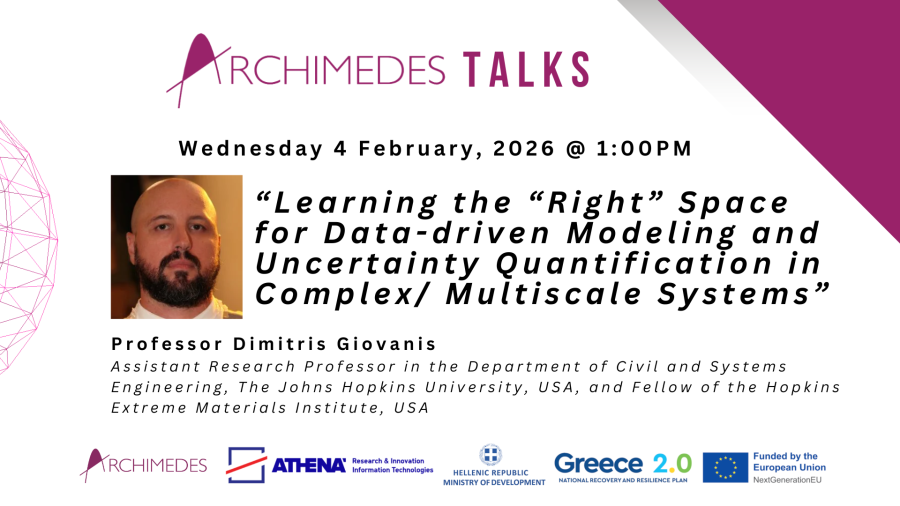
Learning the “Right” Space for Data-driven Modeling and Uncertainty Quantification in Complex/ Multiscale Systems - Dimitris Giovanis (Johns Hopkins University, USA)

Archimedes_Talks___Talk___Giovanis___4_February_final_1
Dates
2026-02-04 13:00 - 14:00
Venue
Archimedes Amphitheatre (1 Artemidos Street, 15125, Marousi, Archimedes, Athena Research Center, Greece)


Title
: Learning the “Right” Space for Data-driven Modeling and Uncertainty Quantification in Complex/Multiscale Systems


Speaker: Prof. Dimitris Giovanis (Johns Hopkins University, United States of America)

Abstract: Obtaining predictive models from data lies at the core of science and engineering modeling. Traditionally, in mathematical modelling, one starts from observations of the world first (with some serious thinking!) to the careful selection of variables, the formulation of governing equations, and the analysis of those equations to make predictions. Good mathematical models give realistic predictions (and inaccurate ones do not). However, several major challenges arise in this process since the complex high-dimensional systems of interest often involve multiple physics, multiple length- and time-scales, as well as nonlinear and history dependent behaviors. To further complicate matters, models must contend with a myriad of uncertainties such as inherent stochasticity (aleatory uncertainty) and uncertainties in model-form (epistemic uncertainties). In response to these challenges, modern mathematical and machine learning (ML) approaches increasingly operate directly on observational data, without relying on explicit variable selection, parameterization, or closed-form governing equations. This shift does not eliminate the underlying scientific effort; rather, it shifts it. The “serious thinking” no longer appears as equations on paper, but as the “right” latent spaces, optimization and probabilistic modeling on manifolds, encoded in algorithms that infer and predict without ever writing down the model they analyze. Our work here presents a couple of efforts that illustrate this "new" path from data to predictions with uncertainty quantification. It really is the same old path, but it is traveled by new means.

Short Biography: Dr. Giovanis is an Assistant Research Professor in the Dept. of Civil & Systems Engineering (with an upcoming secondary appointment in the Dpt. of Applied Mathematics & Statistics) at Johns Hopkins University, USA. Dr. Giovanis develops computational tools & algorithms to accelerate and optimize both traditional modeling and scientific machine learning to very high-dimensional and complex systems, in which computational efficiency is critical, and their behavior is highly unpredictable. His methods are applied across a broad range of domains, including materials science (structural ceramics, energetic materials, carbonbased composites, amorphous solids, additive manufacturing), natural hazards (performance-based engineering, regional hazard modeling, post-wildfire debris flow), health and biomedicine (traumatic brain injury, digital twins of the human heart, epidemic’s modelling, neural organoids), aerospace engineering, and astrophysics (space weather). His work is supported by the National Science Foundation (NSF), the Department of Energy (DOE), and the Defense Advanced Research Projects Agency (DARPA), including a DARPA INTACT Grant and DARPA COMPASS in 2025. Dr. Giovanis is affiliated with the Center on Artificial Intelligence for Materials in Extreme Environments (CAIMEE), the Hopkins Extreme Materials Institute (HEMI), the Mathematical Institute for Data Science (MINDS), the Institute for Data Intensive Engineering and Science (IDIES), and the NHERI’s SimCenter. He is a member of the ASCE/EMI Probabilistic Methods Committee, the ASCE/EMI Machine Learning Group, and member of the SIAM/UQ group. He is also an Assistant Coach for the JHU men’s Water Polo team. Dr. Giovanis holds a PhD in Civil Engineering, a Msc. in Computational Mechanics, and a 5-year diploma in Civil (Structural) Engineering, all from the National Technical University of Athens.


___________________________________________________________________________________________
Microsoft Teams meeting link
Meeting ID: 389 368 115 571 26
Passcode: ah7DD6v4




Vision

To position Greece as a leading player in AI and Data Science

image
image

Mission

To build an AI Excellence Hub in Greece where the international research community can connect, groundbreaking ideas can thrive, and the next generation of scientists emerges, shaping a brighter future for Greece and the world


Welcome to ARCHIMEDES, a vibrant research hub connecting the global AI and Data Science research community fostering groundbreaking research in Greece and beyond. Its dedicated core team, comprising lead researchers, affiliated researchers, Post-Docs, PhDs and interns, is committed to advancing basic and applied research in Artificial Intelligence and its supporting disciplines, including Algorithms, Statistics, Learning Theory, and Game Theory organized around 8 core research areas. By collaborating with Greek and Foreign Universities and Research Institutes, ARCHIMEDES disseminates its research findings fostering knowledge exchange and providing enriching opportunities for students. Leveraging AI to address real-world challenges, ARCHIMEDES promotes innovation within the Greek ecosystem and extends its societal impact. Established in January 2022, as a research unit of the Athena Research Center with support from the Committee Greece 2021, ARCHIMEDES is funded for its first four years by the EU Recovery and Resilience Facility (RRF).


NEWS

 
Archimedes AGT Afternoon Event (ΑAGTA) will take place on 4 February 2026 at Archimedes premises

Archimedes AGT Afternoon Event (ΑAGTA) will take place on 4 February 2026 at Archimedes premises

Archimedes AGT Afternoon Event (ΑAGTA) is a newly-established scientific event, focusing on Algorithmic Game Theory and Artificial Intelligence. The first AAGTA workshop will take place on 4 February 2026 at the Archimedes Amphitheatre at Archimedes Unit, Athena Reseach Center, Greece, and will feature two keynote speeches: one by Prof. Paul Goldberg of the University of Oxford, UK, and one by Prof. Christos Papadimitriou of Columbia University, USA & Archimedes Unit, Athena Reseach Center, Greece.

Archimedes Seminar by Michael I. Jordan on

Archimedes Seminar by Michael I. Jordan on "Nonnegative Supermartingales, Sequential Testing, and Statistical Contract Theory"

On Tuesday 10 February, 2026, from 3:00 pm to 5:00 pm, at the Archimedes Amphitheatre (1 Artemidos Street, 15125, Marousi, Archimedes, Athena Research Center, Greece), Michael I. Jordan (Researcher at Inria Paris, France, and Professor Emeritus in the Department of Electrical Engineering & Computer Science, and in the Department of Statistics at the University of California, Berkeley, USA, will deliver an Archimedes Seminar on "Nonnegative Supermartingales, Sequential Testing, and Statistical Contract Theory."

Archimedes Talk by Jason Milionis on

Archimedes Talk by Jason Milionis on "From Myerson to Automated Markets: New Research Directions in Exchange Design"

On Wednesday 28 January, 2026, from 4:00 pm to 5:00 pm, at the Archimedes Amphitheatre (1 Artemidos Street, 15125, Marousi, Archimedes, Athena Research Center, Greece), Jason Milionis, a 5th and final year Ph.D. candidate in the Computer Science Department at Columbia University, USA, and a Senior Researcher at Category Labs, will deliver an Archimedes talk on "From Myerson to Automated Markets: New Research Directions in Exchange Design."

Archimedes Talk by Dimitris Giovanis on

Archimedes Talk by Dimitris Giovanis on "Learning the “Right” Space for Data-driven Modeling and Uncertainty Quantification in Complex / Multiscale Systems"

On Wednesday 4 February, 2026, from 1:00 pm to 2:00 pm, at the Archimedes Amphitheatre (1 Artemidos Street, 15125, Marousi, Archimedes, Athena Research Center, Greece), Professor Dimitris Giovanis, Assistant Research Professor in the Department of Civil and Systems Engineering, The Johns Hopkins University, USA, and fellow of the Hopkins Extreme Materials Institute, a member of the Center on Artificial Intelligence for Materials in Extreme Environments, the Institute for Data Intensive Engineering and Science, the Johns Hopkins Mathematical Institute for Data Science, and the Data Science and AI Institute, will deliver an Archimedes talk on "Learning the “Right” Space for Data-driven Modeling and Uncertainty Quantification in Complex / Multiscale Systems."

Director Timos Sellis Moderates a Panel on AI and Health Policy

Director Timos Sellis Moderates a Panel on AI and Health Policy

On Thursday, 11 December 2025, during the 2025 Panhellenic Congress on Health Economics and Policy, Professor Timos Sellis moderated an expert panel on ¨How AI May Transform Healthcare and Health Policies” and exchanged views with Professor Costas Athanassakis, Professor Theoklis Zaoutis, Dr. Georgios Papanastasiou, and Dr. Harietta Eleftherochorinou.


The project “ARCHIMEDES Unit: Research in Artificial Intelligence, Data Science and Algorithms” with code OPS 5154714 is implemented by the National Recovery and Resilience Plan “Greece 2.0” and is funded by the European Union – NextGenerationEU.

greece2.0 eu_arch_logo_en


Stay connected! Subscribe to our mailing list by emailing sympa@lists.athenarc.gr
with the subject "subscribe archimedes-news Firstname LastName"
(replace with your details)