
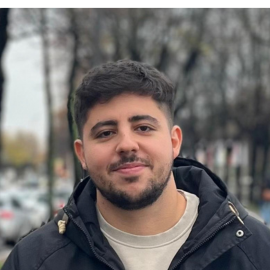
Antonis Karantonis
PhD student (NKUA) & Academic fellow
National and Kapodistrian University of Athens, Greece
Short Bio
Antonis Karantonis is a PhD candidate at the National and Kapodistrian University of Athens (NKUA) and a PhD Fellow at the Archimedes Unit of the Athena Research Center, under the supervision of Prof. Yannis Panagakis. He received his Diploma in Electrical and Computer Engineering from the National Technical University of Athens (NTUA). His research lies at the intersection of deep learning and computational neuroscience, focusing on representation learning for biosignals. He develops foundation models for EEG and Brain-Computer Interfaces using self-supervised and contrastive learning, as well as transformer-based architectures, aiming to achieve strong performance across multiple downstream tasks.
Research Interests
Antonis’ research interests include deep learning, self-supervised representation learning, and foundation models for neurophysiological data, with an emphasis on EEG-based Brain-Computer Interfaces. His work explores scalable learning frameworks that enable robust and transferable representations across subjects and downstream tasks.
Antonis Karantonis is a PhD candidate at the National and Kapodistrian University of Athens (NKUA) and a PhD Fellow at the Archimedes Unit of the Athena Research Center, under the supervision of Prof. Yannis Panagakis. He received his Diploma in Electrical and Computer Engineering from the National Technical University of Athens (NTUA). His research lies at the intersection of deep learning and computational neuroscience, focusing on representation learning for biosignals. He develops foundation models for EEG and Brain-Computer Interfaces using self-supervised and contrastive learning, as well as transformer-based architectures, aiming to achieve strong performance across multiple downstream tasks.
Research Interests
Antonis’ research interests include deep learning, self-supervised representation learning, and foundation models for neurophysiological data, with an emphasis on EEG-based Brain-Computer Interfaces. His work explores scalable learning frameworks that enable robust and transferable representations across subjects and downstream tasks.