Free event - registration required: https://tinyurl.com/2eyk2x65
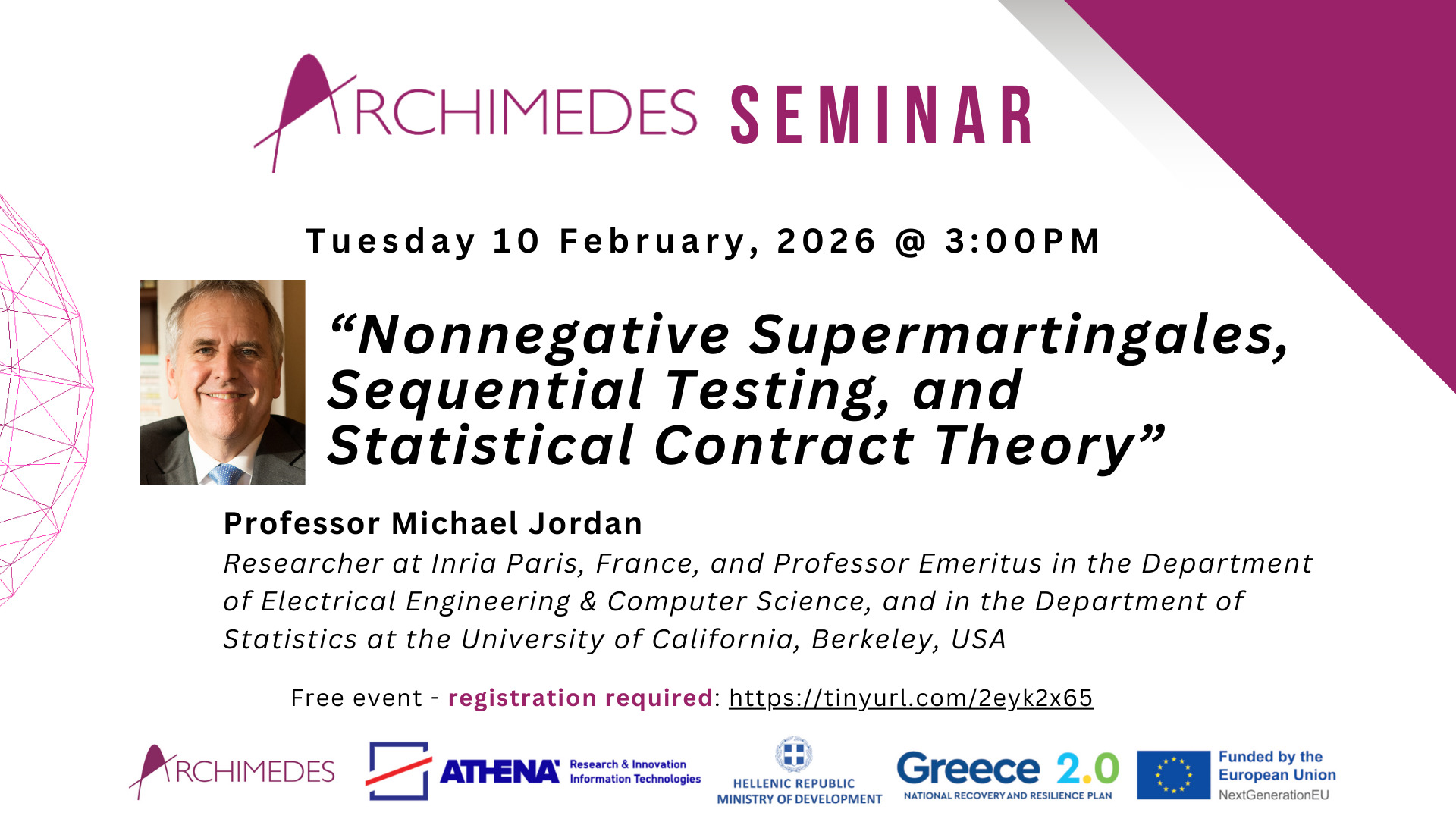
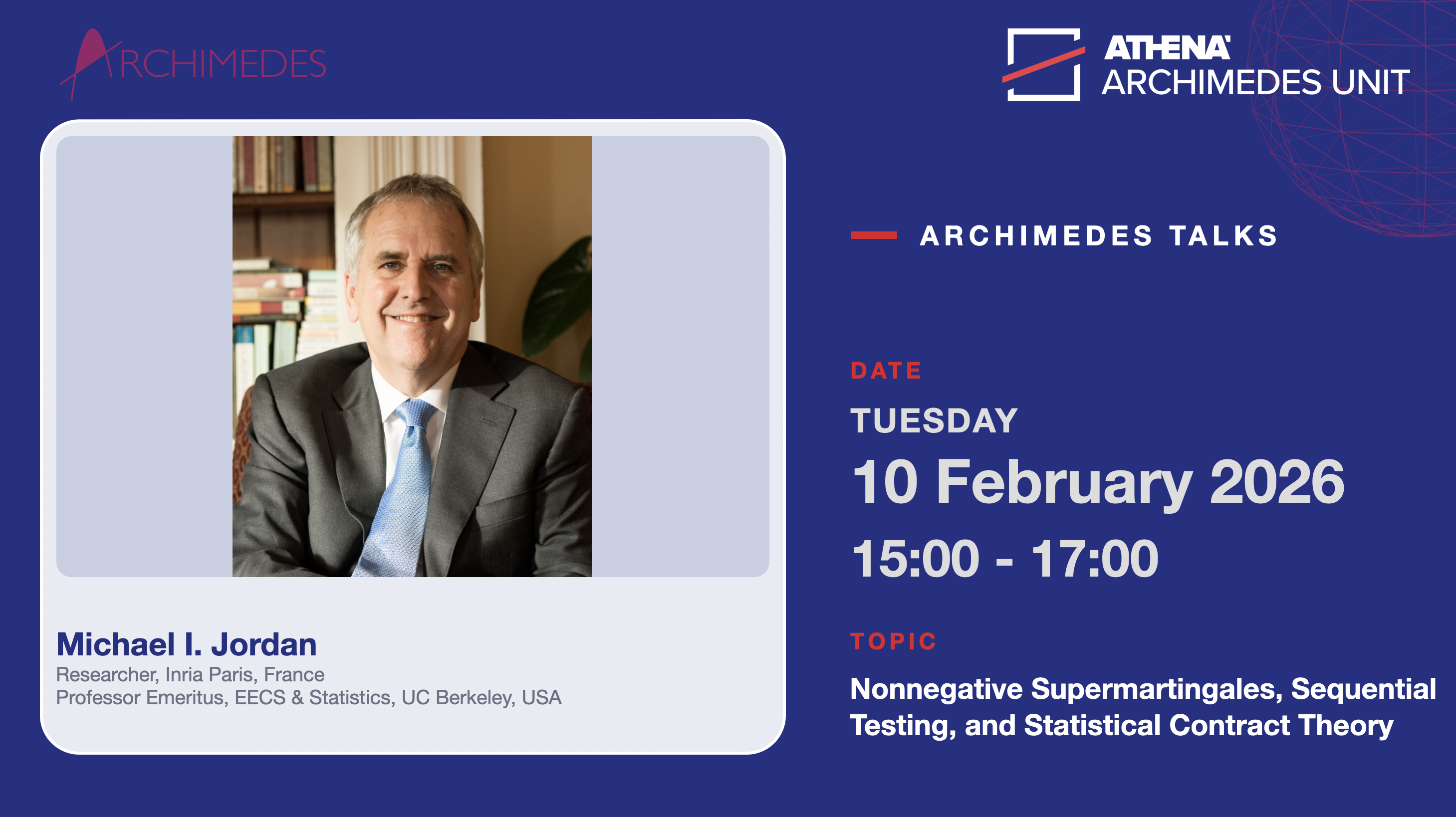
Title: Nonnegative Supermartingales, Sequential Testing, and Statistical Contract Theory
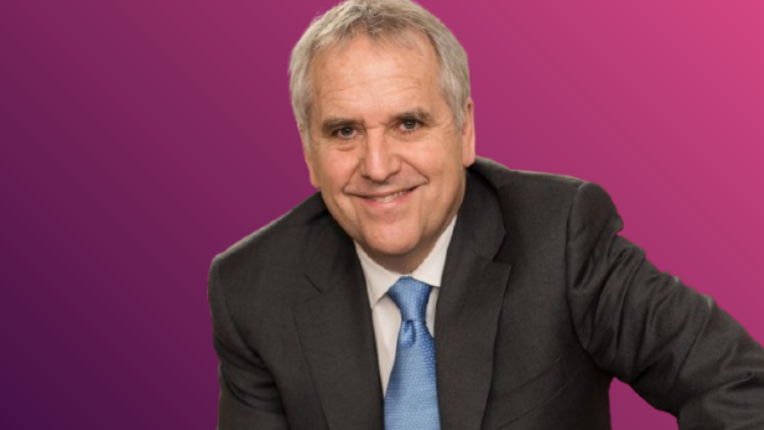
Speaker: Professor Michael Jordan
(Researcher at Inria Paris, France, and Professor Emeritus in the Department of Electrical Engineering & Computer Science, and in the Department of Statistics at the University of California, Berkeley, USA)
Abstract: Sequential hypothesis testing is often formulated as the design of stochastic processes that are nonnegative supermartingales under the null hypothesis. Modern challenges in this area involve nonparametric, composite hypotheses, both for the null and the alternative. I present a general theorem delineating a class of nonnegative supermartingales that have optimal power against composite alternatives. The characterization is based on a deterministic quantity known as the "portfolio regret"---I show that any process exhibiting sublinear portfolio regret is adaptively, asymptotically, and almost surely log-optimal. In the second half of the talk I present an application of these ideas to an emerging area at the intersection of statistical inference and economic mechanism design. Specifically, I discuss a game-theoretic problem involving a Principal who wishes to perform tests of hypotheses, where the choice of hypotheses is made by a strategic, self-interested Agent. I show that incentive compatibility in this game is assured if and only if the contract provided by the Principal to the Agent is comprised of a set of nonnegative supermartingales. [Joint work with Stephen Bates, Ricardo Sandoval, Michael Sklar, Jake Soloff, and Ian Waudby-Smith.]
Speaker Biography: Michael Jordan is Researcher at Inria Paris, France, and Professor Emeritus in the Department of Electrical Engineering & Computer Science, and in the Department of Statistics at the University of California, Berkeley, USA. He received his Masters in Mathematics from Arizona State University, and earned his PhD in Cognitive Science in 1985 from the University of California, San Diego. He was a professor at MIT from 1988 to 1998. His research interests bridge the computational, statistical, cognitive, biological and social sciences. Prof. Jordan is a member of the National Academy of Sciences, a member of the National Academy of Engineering, a member of the American Academy of Arts and Sciences, and a Foreign Member of the Royal Society. He is a Fellow of the American Association for the Advancement of Science. He was the inaugural winner of the World Laureates Association (WLA) Prize in 2022. He received the Ulf Grenander Prize from the American Mathematical Society in 2021, the IEEE John von Neumann Medal in 2020, the IJCAI Research Excellence Award in 2016, the David E. Rumelhart Prize in 2015, and the ACM/AAAI Allen Newell Award in 2009. He gave the Inaugural IMS Grace Wahba Lecture in 2022, the IMS Neyman Lecture in 2011, and an IMS Medallion Lecture in 2004. He was a Plenary Lecturer at the International Congress of Mathematicians in 2018.
In 2016, Professor Michael I. Jordan was named the "most influential computer scientist" worldwide in an article in Science, based on rankings from the Semantic Scholar search engine.
👉 Join us online!
Meeting ID: 312 529 394 792 68
Passcode: b5Hj7mK7